Signals and Systems
Unlocking Signals: A Journey Through Transforms
Imron Rosyadi
Unlocking Signals: A Journey Through Transforms
Fourier, Laplace, and Z-Transforms in ECE
Why Transforms? Bridging Time and Frequency
Signals and Systems often involve complex behaviors that are difficult to analyze solely in the time domain.
Time Domain (\(x(t)\) or \(x[n]\))
- Direct representation of signal values over time.
- Intuitive for transient behavior, direct measurements.
- Can be challenging for:
- Identifying constituent frequencies.
- Analyzing system response to various frequencies.
- Solving differential/difference equations.
Frequency Domain (\(X(\omega)\) or \(X(s)\) or \(X(z)\))
- Represents the signal’s frequency content.
- Reveals harmonics, bandwidth, and spectral characteristics.
- Simplifies:
- System analysis (e.g., filter design).
- Solving complex system equations (algebraic instead of calculus).
- Analogy: A musical chord (time domain) can be broken down into individual notes (frequency domain).
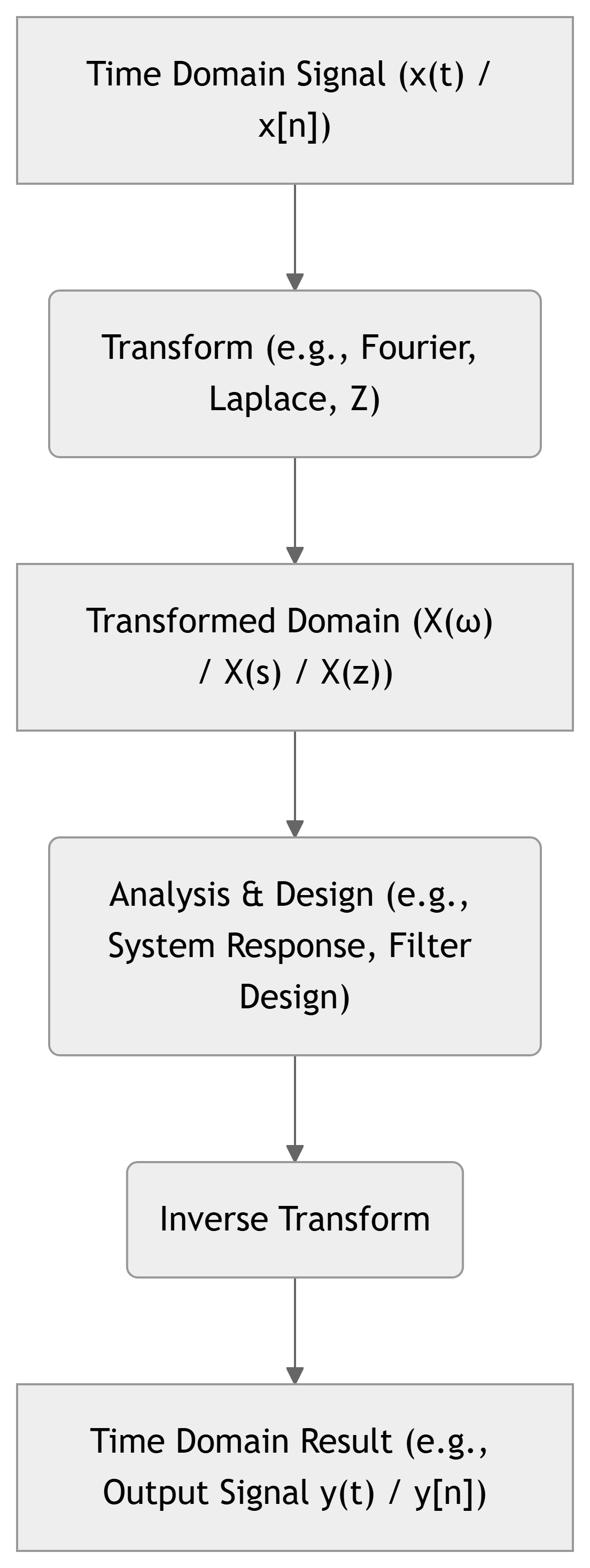
The Transform Pipeline
Signals are transformed, analyzed, and sometimes transformed back.
1. Continuous-Time Fourier Series (CTFS)
For Periodic Continuous-Time Signals
Definition: Represents a periodic continuous-time signal \(x(t)\) with period \(T_0\) as a sum of harmonically related complex exponentials.
Purpose: To analyze the harmonic content of periodic continuous-time signals. It decomposes a complex periodic waveform into its fundamental frequency and its integer multiples (harmonics).
1. Analysis Equation (Finding Coefficients) \[ c_k = \frac{1}{T_0} \int_{T_0} x(t) e^{-jk\omega_0 t} dt \] Where \(\omega_0 = \frac{2\pi}{T_0}\) is the fundamental angular frequency.
2. Synthesis Equation (Reconstructing Signal) \[ x(t) = \sum_{k=-\infty}^{\infty} c_k e^{jk\omega_0 t} \] This shows how the original signal is built from its harmonic components.
Tip
Applications:
- Power Systems: Analyzing harmonic distortion in AC power grids.
- Audio Synthesis: Creating complex waveforms by combining simple sine waves.
- Communications: Understanding the spectral components of modulated carriers (e.g., AM).
2. Discrete-Time Fourier Series (DTFS)
For Periodic Discrete-Time Signals
Definition: Represents a periodic discrete-time signal \(x[n]\) with period \(N_0\) as a finite sum of harmonically related complex exponentials.
Purpose: To analyze the harmonic content of periodic discrete-time signals. It’s the discrete-time counterpart to the CTFS.
1. Analysis Equation (Finding Coefficients) \[ a_k = \frac{1}{N_0} \sum_{n=\left<N_0\right>} x[n] e^{-jk(2\pi/N_0)n} \] The sum is over any one period of \(N_0\) samples.
2. Synthesis Equation (Reconstructing Signal) \[ x[n] = \sum_{k=\left<N_0\right>} a_k e^{jk(2\pi/N_0)n} \] The sum over \(k\) is also over any one period of \(N_0\) values.
Tip
Applications:
- Digital Audio: Understanding the spectral components of sampled periodic sounds.
- Digital Communications: Principles behind Orthogonal Frequency-Division Multiplexing (OFDM).
- Digital Signal Processing (DSP): Analyzing periodic sequences in algorithms.
3. Continuous-Time Fourier Transform (CTFT)
For Aperiodic Continuous-Time Signals
Definition: Extends the Fourier Series concept to aperiodic continuous-time signals, representing them as an integral (instead of a sum) of complex exponentials over a continuous range of frequencies.
Purpose: To analyze the frequency content of non-periodic continuous-time signals and to analyze continuous-time LTI systems.
1. Analysis Equation (Forward Transform) \[ X(j\omega) = \int_{-\infty}^{\infty} x(t) e^{-j\omega t} dt \] This maps the time-domain signal \(x(t)\) to its frequency-domain representation \(X(j\omega)\).
2. Synthesis Equation (Inverse Transform) \[ x(t) = \frac{1}{2\pi} \int_{-\infty}^{\infty} X(j\omega) e^{j\omega t} d\omega \] This reconstructs the time-domain signal from its frequency components.
Tip
Applications:
- Filter Design: Designing analog filters based on desired frequency responses.
- Modulation: Understanding the spectral shifts in AM/FM radio.
- Medical Imaging: Principles behind Magnetic Resonance Imaging (MRI).
- Signal Analysis: Analyzing the spectral content of speech, music, or seismic data.
4. Discrete-Time Fourier Transform (DTFT)
For Aperiodic Discrete-Time Signals
Definition: Extends the Fourier Series concept to aperiodic discrete-time signals, representing them as a sum of complex exponentials over a continuous, but periodic, frequency range.
Purpose: To analyze the frequency content of non-periodic discrete-time signals and to analyze discrete-time LTI systems.
1. Analysis Equation (Forward Transform)
\[ X(e^{j\omega}) = \sum_{n=-\infty}^{\infty} x[n] e^{-j\omega n} \]
This maps the discrete-time signal \(x[n]\) to its continuous and periodic frequency-domain representation \(X(e^{j\omega})\).
2. Synthesis Equation (Inverse Transform)
\[ x[n] = \frac{1}{2\pi} \int_{2\pi} X(e^{j\omega}) e^{j\omega n} d\omega \]
This reconstructs the discrete-time signal from its continuous and periodic frequency components.
Tip
Applications:
- Digital Filter Design: Designing FIR/IIR filters with specific frequency responses.
- Digital Audio Processing: Equalization, effects, noise reduction.
- Image Processing: Frequency-domain filtering for image enhancement/compression.
- Sampling Theory: Understanding aliasing and reconstruction of signals.
5. Laplace Transform
For Continuous-Time LTI Systems & Initial Conditions
Definition: A generalization of the CTFT that transforms a continuous-time signal \(x(t)\) from the time domain into the complex frequency domain (s-plane). It works for a broader class of signals than the CTFT, including unstable signals.
Purpose:
- Analyze continuous-time LTI systems, especially those with initial conditions.
- Solve linear differential equations.
- Determine system stability, causality, and frequency response.
Equation (Unilateral Laplace Transform):
\[ X(s) = \int_{0^-}^{\infty} x(t) e^{-st} dt \]
Where \(s = \sigma + j\omega\) is a complex frequency variable.
Important
Region of Convergence (ROC): Crucial for uniqueness and understanding system properties (stability, causality).
Tip
Applications:
- Control Systems: Designing controllers, analyzing system stability (pole-zero plots, root locus).
- Analog Circuit Analysis: Solving RLC circuit transient and steady-state responses.
- System Modeling: Representing complex physical systems with transfer functions.
Laplace Transform: Pole-Zero Plot Concept
Poles and zeros in the s-plane describe system behavior and stability.
Warning
Stability: For a causal LTI system, stability requires all poles to be in the left-half of the s-plane (LHP). The Region of Convergence (ROC) must include the \(j\omega\)-axis for the Fourier Transform to exist.
6. Z-Transform
For Discrete-Time LTI Systems & Initial Conditions
Definition: A generalization of the DTFT that transforms a discrete-time signal \(x[n]\) from the time domain into the complex frequency domain (z-plane). It works for a broader class of signals than the DTFT.
Purpose:
- Analyze discrete-time LTI systems, especially those with initial conditions.
- Solve linear difference equations.
- Determine system stability, causality, and frequency response.
Equation (Unilateral Z-Transform):
\[ X(z) = \sum_{n=0}^{\infty} x[n] z^{-n} \]
Where \(z\) is a complex variable.
Important
Region of Convergence (ROC): Essential for uniqueness and understanding system properties (stability, causality).
Tip
Applications:
- Digital Filter Design: Designing IIR/FIR digital filters.
- Digital Control Systems: Analyzing and designing discrete-time feedback systems.
- Discrete-Time System Modeling: Representing digital systems with transfer functions.
Z-Transform: Pole-Zero Plot Concept
Poles and zeros in the z-plane describe discrete-time system behavior and stability.
Warning
Stability: For a causal LTI system, stability requires all poles to be inside the unit circle in the z-plane. The Region of Convergence (ROC) must include the unit circle for the DTFT to exist.
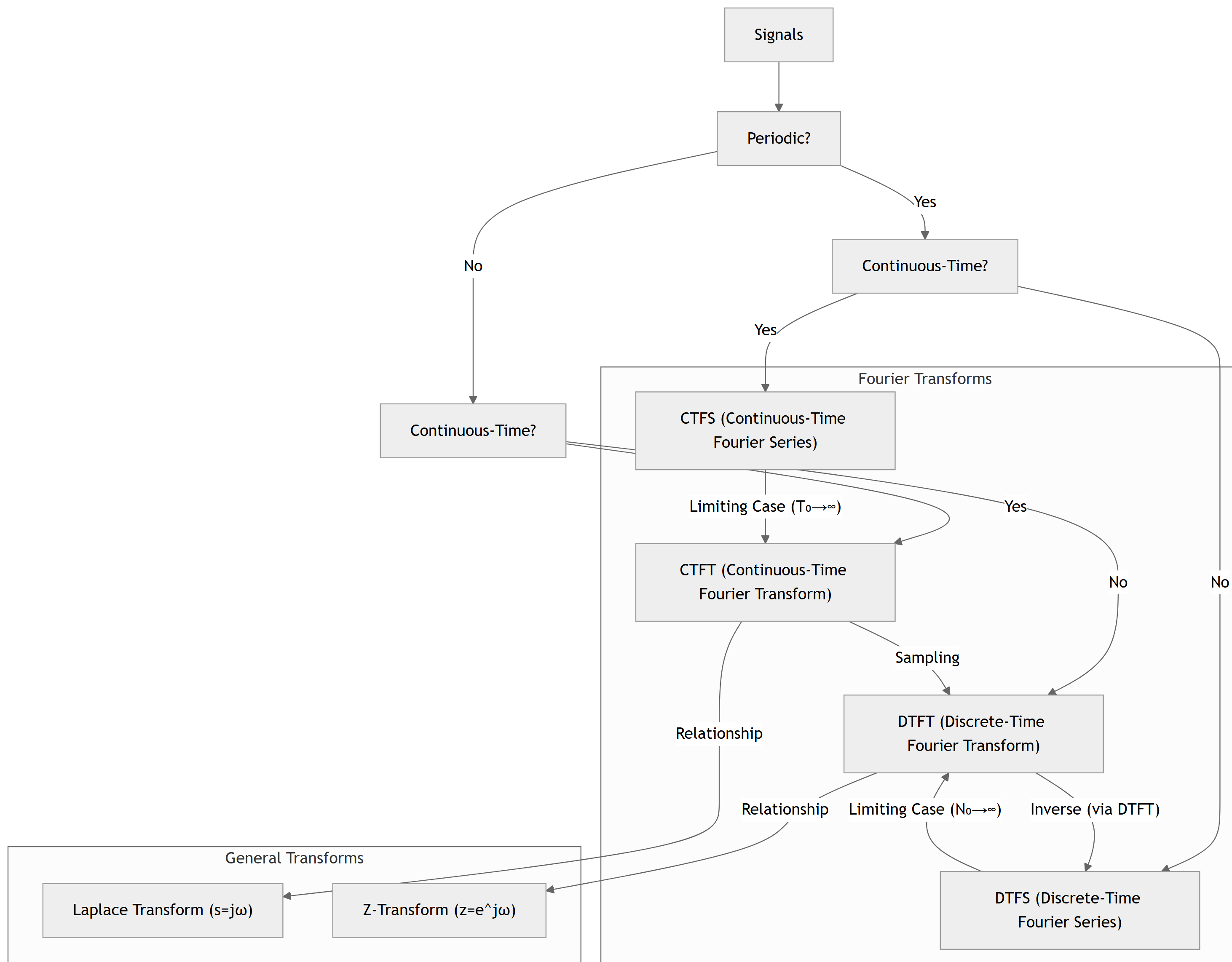
The Fourier Family Tree
Connecting the different Fourier-based transforms.
The Rectangular Pulse: Our Test Signal
Continuous-Time Rectangular Pulse
Defined as: \[x(t) = \begin{cases} A & |t| \le \frac{\tau}{2} \\ 0 & |t| > \frac{\tau}{2} \end{cases} = A \cdot \text{rect}\left(\frac{t}{\tau}\right)\]
- \(A\): Amplitude
- \(\tau\): Duration
Tip
This signal represents a short burst of energy, common in digital communication, radar, and sampling.
Interactive: Continuous Rectangular Pulse
Adjust the amplitude and duration to see its shape.
Discrete-Time Rectangular Pulse
Defined as:
\[x[n] = \begin{cases} A & -N_1 \le n \le N_1 \\ 0 & \text{otherwise} \end{cases}\]
- \(A\): Amplitude
- \(2N_1+1\): Length of the pulse
Warning
Discrete signals are defined only at integer values of \(n\).
Fourier Series: Periodic Signals
Continuous-Time Fourier Series (CTFS)
For a periodic signal \(x(t)\) with period \(T_0\), CTFS decomposes it into a sum of complex exponentials:
\[x(t) = \sum_{k=-\infty}^{\infty} c_k e^{j k \omega_0 t}\] where \(\omega_0 = \frac{2\pi}{T_0}\) is the fundamental frequency, and the coefficients are:
\[c_k = \frac{1}{T_0} \int_{T_0} x(t) e^{-j k \omega_0 t} dt\]
CTFS of a Periodic Rectangular Wave
Consider a periodic rectangular wave \(x(t)\) with amplitude \(A\), pulse width \(\tau\), and period \(T_0\).
\[c_k = \frac{1}{T_0} \int_{-\tau/2}^{\tau/2} A e^{-j k \omega_0 t} dt\] \[c_k = \frac{A}{T_0} \left[ \frac{e^{-j k \omega_0 t}}{-j k \omega_0} \right]_{-\tau/2}^{\tau/2} = \frac{A}{T_0} \frac{e^{j k \omega_0 \tau/2} - e^{-j k \omega_0 \tau/2}}{j k \omega_0}\] \[c_k = \frac{A}{T_0} \frac{2 \sin(k \omega_0 \tau/2)}{k \omega_0} = \frac{A \tau}{T_0} \frac{\sin(k \omega_0 \tau/2)}{k \omega_0 \tau/2}\] \[c_k = \frac{A \tau}{T_0} \text{sinc}\left(\frac{k \omega_0 \tau}{2\pi}\right) = \frac{A \tau}{T_0} \text{sinc}\left(\frac{k \tau}{T_0}\right)\]
Discrete-Time Fourier Series (DTFS)
For a periodic discrete-time signal \(x[n]\) with period \(N\), DTFS expresses it as: \[x[n] = \sum_{k=0}^{N-1} c_k e^{j k \frac{2\pi}{N} n}\] where the coefficients are given by: \[c_k = \frac{1}{N} \sum_{n=0}^{N-1} x[n] e^{-j k \frac{2\pi}{N} n}\]
DTFS of a Periodic Discrete Rectangular Wave
Consider a periodic discrete rectangular wave \(x[n]\) with amplitude \(A\), length \(L\) (from \(n=0\) to \(L-1\)), and period \(N\).
\[c_k = \frac{1}{N} \sum_{n=0}^{L-1} A e^{-j k \frac{2\pi}{N} n}\] This is a geometric series sum: \[c_k = \frac{A}{N} \frac{1 - e^{-j k \frac{2\pi}{N} L}}{1 - e^{-j k \frac{2\pi}{N}}}\] Using Euler’s formula and simplifying: \[c_k = \frac{A}{N} e^{-j k \frac{\pi(L-1)}{N}} \frac{\sin\left(\frac{k \pi L}{N}\right)}{\sin\left(\frac{k \pi}{N}\right)}\]
Fourier Transforms: Aperiodic Signals
Continuous-Time Fourier Transform (CTFT)
For an aperiodic signal \(x(t)\), CTFT transforms it from time to continuous frequency domain \(\Omega\): \[X(j\Omega) = \int_{-\infty}^{\infty} x(t) e^{-j \Omega t} dt\] Inverse CTFT: \[x(t) = \frac{1}{2\pi} \int_{-\infty}^{\infty} X(j\Omega) e^{j \Omega t} d\Omega\]
Important
CTFT applies to non-periodic signals with finite energy. The result \(X(j\Omega)\) is generally a complex-valued function of continuous frequency \(\Omega\).
CTFT of a Single Rectangular Pulse
For \(x(t) = A \cdot \text{rect}\left(\frac{t}{\tau}\right)\): \[X(j\Omega) = \int_{-\tau/2}^{\tau/2} A e^{-j \Omega t} dt\] \[X(j\Omega) = A \left[ \frac{e^{-j \Omega t}}{-j \Omega} \right]_{-\tau/2}^{\tau/2} = A \frac{e^{j \Omega \tau/2} - e^{-j \Omega \tau/2}}{j \Omega}\] \[X(j\Omega) = A \frac{2 \sin(\Omega \tau/2)}{\Omega} = A \tau \frac{\sin(\Omega \tau/2)}{\Omega \tau/2}\] \[X(j\Omega) = A \tau \text{sinc}\left(\frac{\Omega \tau}{2\pi}\right)\]
Interactive: CTFT of a Rectangular Pulse
Observe how the spectrum changes with pulse duration.
Discrete-Time Fourier Transform (DTFT)
For an aperiodic discrete-time signal \(x[n]\), DTFT transforms it from discrete time to continuous frequency \(\omega\): \[X(e^{j\omega}) = \sum_{n=-\infty}^{\infty} x[n] e^{-j \omega n}\] Inverse DTFT: \[x[n] = \frac{1}{2\pi} \int_{-\pi}^{\pi} X(e^{j\omega}) e^{j \omega n} d\omega\]
Important
DTFT produces a frequency spectrum that is periodic with period \(2\pi\). This is a direct consequence of the discrete nature of the time-domain signal.
DTFT of a Single Discrete Rectangular Pulse
For \(x[n] = A\) for \(-N_1 \le n \le N_1\) (length \(L = 2N_1+1\)): \[X(e^{j\omega}) = \sum_{n=-N_1}^{N_1} A e^{-j \omega n}\] Let \(m = n+N_1\), so \(n = m-N_1\): \[X(e^{j\omega}) = A \sum_{m=0}^{2N_1} e^{-j \omega (m-N_1)} = A e^{j \omega N_1} \sum_{m=0}^{L-1} e^{-j \omega m}\] This is a geometric series sum: \[X(e^{j\omega}) = A e^{j \omega N_1} \frac{1 - e^{-j \omega L}}{1 - e^{-j \omega}}\] \[X(e^{j\omega}) = A e^{j \omega N_1} \frac{e^{-j \omega L/2} (e^{j \omega L/2} - e^{-j \omega L/2})}{e^{-j \omega/2} (e^{j \omega/2} - e^{-j \omega/2})}\] \[X(e^{j\omega}) = A e^{j \omega (N_1 - L/2 + 1/2)} \frac{\sin(\omega L/2)}{\sin(\omega/2)}\] Since \(N_1 - L/2 + 1/2 = N_1 - (2N_1+1)/2 + 1/2 = N_1 - N_1 - 1/2 + 1/2 = 0\): \[X(e^{j\omega}) = A \frac{\sin(\omega L/2)}{\sin(\omega/2)}\]
Interactive: DTFT of a Discrete Rectangular Pulse
Adjust the pulse length (\(L\)) and see its periodic spectrum.
System-Oriented Transforms
Laplace Transform
For continuous-time signals \(x(t)\), the Laplace Transform \(X(s)\) extends the CTFT to complex frequencies \(s = \sigma + j\Omega\): \[X(s) = \int_{-\infty}^{\infty} x(t) e^{-s t} dt\]
- Unilateral Laplace Transform: \(X(s) = \int_{0}^{\infty} x(t) e^{-s t} dt\) (for causal signals)
- Region of Convergence (ROC): The range of \(s\) for which the integral converges. Crucial for uniqueness and causality/stability.
Note
Laplace Transform is powerful for analyzing LTI systems, especially for initial conditions, stability, and causality, as it transforms differential equations into algebraic equations.
Laplace Transform of a Rectangular Pulse
Consider a causal rectangular pulse: \(x(t) = A \left[ u(t) - u(t-\tau) \right]\) \[X(s) = \int_{0}^{\infty} A \left[ u(t) - u(t-\tau) \right] e^{-s t} dt\] \[X(s) = A \int_{0}^{\tau} e^{-s t} dt = A \left[ \frac{e^{-s t}}{-s} \right]_{0}^{\tau}\] \[X(s) = A \left( \frac{e^{-s \tau}}{-s} - \frac{1}{-s} \right) = A \frac{1 - e^{-s \tau}}{s}\]
- ROC: For this causal signal, the integral converges for \(\text{Re}\{s\} > 0\).
Pole-Zero Diagram for Laplace Transform
A common form of \(X(s)\) or \(H(s)\) is \(\frac{N(s)}{D(s)}\). Poles are roots of \(D(s)=0\), Zeros are roots of \(N(s)=0\).
Z-Transform
For discrete-time signals \(x[n]\), the Z-Transform \(X(z)\) extends the DTFT to complex variable \(z = r e^{j\omega}\): \[X(z) = \sum_{n=-\infty}^{\infty} x[n] z^{-n}\]
- Unilateral Z-Transform: \(X(z) = \sum_{n=0}^{\infty} x[n] z^{-n}\) (for causal signals)
- Region of Convergence (ROC): The range of \(z\) for which the sum converges. Crucial for uniqueness and causality/stability.
Note
The Z-Transform is the discrete-time counterpart to the Laplace Transform, used for analyzing discrete-time LTI systems by transforming difference equations into algebraic equations.
Z-Transform of a Discrete Rectangular Pulse
Consider a causal discrete rectangular pulse: \(x[n] = A \left[ u[n] - u[n-L] \right]\) \[X(z) = \sum_{n=0}^{L-1} A z^{-n} = A \sum_{n=0}^{L-1} (z^{-1})^n\] This is a geometric series sum: \[X(z) = A \frac{1 - (z^{-1})^L}{1 - z^{-1}} = A \frac{1 - z^{-L}}{1 - z^{-1}} = A \frac{z^L - 1}{z^{L-1}(z-1)}\]
- ROC: For this causal signal, the sum converges for \(|z| > 0\).
Pole-Zero Diagram for Z-Transform
Poles are roots of \(D(z)=0\), Zeros are roots of \(N(z)=0\). Stability requires all poles to be inside the unit circle.
Comparative Analysis: Fourier vs. Laplace/Z
Fourier Transforms (CTFS, DTFS, CTFT, DTFT)
- Domain: Real frequency axis (\(j\omega\) or \(\omega\)).
- Purpose: Primarily for spectral analysis – understanding the frequency content of signals.
- Convergence: Generally requires signals to be absolutely integrable/summable for transforms to exist.
- System Analysis: Good for steady-state response of stable LTI systems.
- Initial Conditions: Does not naturally handle initial conditions.
Laplace & Z-Transforms
- Domain: Complex frequency plane (s-plane or z-plane).
- Purpose: Primarily for system analysis – solving differential/difference equations, stability, causality, transient response.
- Convergence: Defined by a Region of Convergence (ROC), allowing analysis of a wider class of signals (e.g., growing exponentials).
- System Analysis: Excellent for transient and steady-state response, stability, and causality of LTI systems.
- Initial Conditions: Unilateral transforms naturally incorporate initial conditions.
CTFS vs. DTFS: Comparing Periodic Signal Analysis
While both analyze periodic signals, their domains lead to distinct properties.
Continuous-Time Fourier Series (CTFS)
- Signal Type: Periodic Continuous-Time \(x(t)\)
- Spectrum: Discrete set of frequency components (\(c_k\))
- Number of Coefficients: Infinite (\(k \in [-\infty, \infty]\))
- Frequency Range: Covers an infinite range of harmonics (\(\pm k\omega_0\))
- Equations: Involves integrals for analysis, infinite sum for synthesis.
- Key Implication: A continuous-time signal can have an infinite number of unique harmonic components.
Tip
Analogy: A continuous orchestra playing an infinitely complex repeating tune, with each instrument representing a unique harmonic.
Discrete-Time Fourier Series (DTFS)
- Signal Type: Periodic Discrete-Time \(x[n]\)
- Spectrum: Discrete set of frequency components (\(a_k\))
- Number of Coefficients: Finite (\(N_0\) unique coefficients, \(k \in [0, N_0-1]\))
- Frequency Range: Covers a finite range of harmonics (periodic over \(2\pi\))
- Equations: Involves finite sums for both analysis and synthesis.
- Key Implication: Due to sampling, only a finite number of unique harmonic components exist within any \(2\pi\) frequency range.
Tip
Analogy: A digital synthesizer playing a repeating loop, but only capable of producing a finite number of distinct notes within its octave.
CTFT vs. DTFT: Comparing Aperiodic Signal Analysis
Both analyze aperiodic signals, but the discrete-time nature introduces periodicity in the frequency domain.
Continuous-Time Fourier Transform (CTFT)
- Signal Type: Aperiodic Continuous-Time \(x(t)\)
- Spectrum: Continuous and Aperiodic \(X(j\omega)\)
- Frequency Range: Extends over all frequencies \((-\infty, \infty)\)
- Equations: Involves integrals for both forward and inverse transforms.
- Key Implication: Represents the exact frequency content of any continuous-time signal.
Important
Condition: Requires \(x(t)\) to be absolutely integrable for \(X(j\omega)\) to exist in the classical sense.
Discrete-Time Fourier Transform (DTFT)
- Signal Type: Aperiodic Discrete-Time \(x[n]\)
- Spectrum: Continuous but Periodic \(X(e^{j\omega})\) (period \(2\pi\))
- Frequency Range: Typically analyzed over one period, e.g., \([-\pi, \pi]\) or \([0, 2\pi]\).
- Equations: Involves an infinite sum for the forward transform, integral for the inverse.
- Key Implication: The periodicity of the spectrum is a direct consequence of the discrete-time sampling. This leads to phenomena like aliasing.
Warning
Condition: Requires \(x[n]\) to be absolutely summable for \(X(e^{j\omega})\) to exist.
Laplace vs. Z-Transform: Comparing System Analysis
These are the powerful tools for LTI system analysis, each suited to its respective domain.
Laplace Transform
- Domain: s-plane (complex plane, \(s = \sigma + j\omega\))
- Signal Type: Continuous-Time (CT) signals
- Equations: Defined by an integral \(\int x(t) e^{-st} dt\)
- Stability: For causal LTI systems, all poles must be in the Left-Half Plane (LHP).
- ROC: Region in the s-plane, typically a half-plane.
- Relation to Fourier: The CTFT is the Laplace Transform evaluated on the \(j\omega\)-axis (if ROC includes it).
- Primary Use: Solving differential equations, analyzing CT LTI systems, especially with initial conditions.
Tip
Think: Analyzing analog circuits, continuous control systems, mechanical vibrations.
Z-Transform
- Domain: z-plane (complex plane, \(z = r e^{j\theta}\))
- Signal Type: Discrete-Time (DT) signals
- Equations: Defined by a sum \(\sum x[n] z^{-n}\)
- Stability: For causal LTI systems, all poles must be inside the unit circle.
- ROC: Region in the z-plane, typically an annulus, or outside/inside a circle.
- Relation to Fourier: The DTFT is the Z-Transform evaluated on the unit circle (if ROC includes it).
- Primary Use: Solving difference equations, analyzing DT LTI systems, especially with initial conditions.
Tip
Think: Analyzing digital filters, digital control systems, discrete-time communication systems.
Summary Table of Analytical Tools
| Tool | Signal Type | Domain | Key Use | Convergence/ROC |
|---|---|---|---|---|
| CTFS | Periodic CT | Discrete Freq (\(k\omega_0\)) | Harmonic analysis of periodic signals | Always exists for finite energy periodic signals |
| DTFS | Periodic DT | Discrete Freq (\(k\frac{2\pi}{N_0}\)) | Harmonic analysis of periodic sequences | Always exists for finite energy periodic sequences |
| CTFT | Aperiodic CT | Continuous Freq (\(j\omega\)) | Spectral analysis of continuous signals | Requires absolute integrability, or generalized FT |
| DTFT | Aperiodic DT | Continuous & Periodic Freq (\(e^{j\omega}\)) | Spectral analysis of discrete signals | Requires absolute summability |
| Laplace | Any CT | Complex s-plane (\(s=\sigma+j\omega\)) | LTI System analysis, DE solving, Stability | Defined by ROC in s-plane |
| Z-Transform | Any DT | Complex z-plane (\(z=re^{j\theta}\)) | LTI System analysis, Diff. Eq. solving, Stability | Defined by ROC in z-plane |
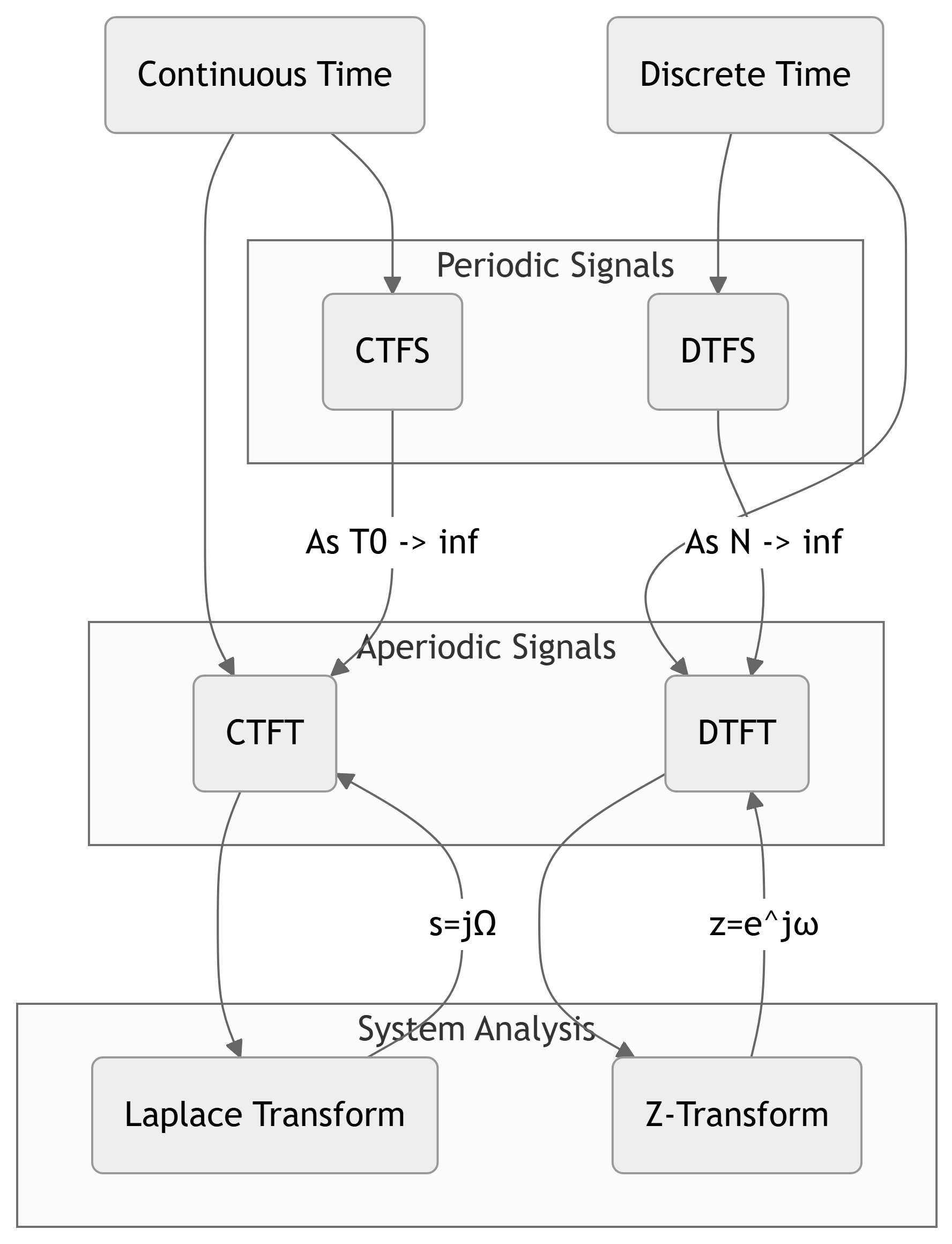
Comparison of Transforms
Fourier Series/Transforms
- CTFS: Periodic \(x(t) \leftrightarrow\) Discrete, aperiodic \(c_k\)
- DTFS: Periodic \(x[n] \leftrightarrow\) Discrete, periodic \(c_k\)
- CTFT: Aperiodic \(x(t) \leftrightarrow\) Continuous, aperiodic \(X(j\Omega)\)
- DTFT: Aperiodic \(x[n] \leftrightarrow\) Continuous, periodic \(X(e^{j\omega})\)
Laplace/Z-Transforms
- Laplace: Continuous \(x(t) \leftrightarrow\) Complex \(X(s)\)
- Includes stability, causality (ROC).
- Z-Transform: Discrete \(x[n] \leftrightarrow\) Complex \(X(z)\)
- Includes stability, causality (ROC).
Tip
Key Idea: Fourier transforms reveal frequency content. Laplace/Z transforms analyze system behavior, including stability and causality.
Transform Relationships
Applications in ECE: Where Transforms Shine
These transforms are not just theoretical constructs; they are the bedrock of modern ECE.
1. Communications Systems
- Modulation/Demodulation: Fourier transforms reveal how signals are shifted and spread in frequency.
- Wireless Technologies: OFDM (DTFS/DTFT), channel equalization (Z-Transform).
2. Control Systems
- System Stability: Laplace/Z-transforms define poles for stability analysis.
- Controller Design: Root locus, Bode plots, frequency response analysis.
3. Digital Signal Processing (DSP)
- Filter Design: DTFT/Z-Transform are fundamental for FIR/IIR filters.
- Audio/Image Processing: Spectral analysis, compression, enhancement.
4. Circuit Analysis
- Transient Response: Laplace transform simplifies RLC circuit analysis.
- Frequency Response: CTFT/Laplace helps understand filter characteristics.
5. Medical Imaging
- MRI (Magnetic Resonance Imaging): Heavily relies on the Fourier Transform to reconstruct images from raw data.
- Ultrasound: Signal processing for image formation.
6. Power Systems
- Harmonic Analysis: CTFS is used to analyze and mitigate harmonics in power grids.
Tip
Takeaway: A deep understanding of these transforms empowers you to design, analyze, and troubleshoot a vast array of ECE systems and devices.
Conclusion: Your Toolkit for Signals and Systems
You now have an overview of the fundamental analytical tools in Signals and Systems.
Fourier Series/Transforms: Essential for understanding the frequency content of signals.
- CTFS for periodic CT, DTFS for periodic DT.
- CTFT for aperiodic CT, DTFT for aperiodic DT.
Laplace Transform: Crucial for continuous-time LTI system analysis, stability, and initial conditions.
Z-Transform: Indispensable for discrete-time LTI system analysis, stability, and initial conditions.
Important
Each transform offers a unique “lens” to view and understand signals and systems. Mastering them is key to becoming a proficient ECE engineer.