Signals and Systems

7.2 Signal Reconstruction

Imron Rosyadi

Signal Reconstruction

From Samples to Continuous Signals

The Challenge of Reconstruction

  • Digital World: Most modern systems process signals in discrete, sampled form.
  • Analog World: Our physical world, however, is inherently continuous.
  • The Bridge: How do we convert back from discrete samples to a continuous signal that accurately represents the original?

Important

Goal: To recover the original continuous-time signal \(x(t)\) from its discrete samples \(x(nT)\).

Figure 7.9: Linear interpolation between sample points. The dashed curve represents the original signal and the solid curve the linear interpolation.

Ideal Reconstruction: The Sampling Theorem’s Promise

  • Recall: For a band-limited signal \(x(t)\) with maximum frequency \(\omega_M\), if sampled at a rate \(\omega_s \ge 2\omega_M\) (Nyquist rate), exact reconstruction is theoretically possible.
  • The Tool: An ideal lowpass filter.

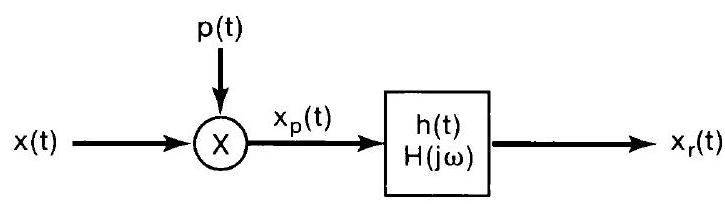
System Model:

  • Samples \(x(nT)\) are converted to an impulse train \(x_p(t)\).
  • This impulse train passes through an ideal lowpass filter \(H(j\omega)\).
  • The output \(x_r(t)\) is the reconstructed signal.

\[ x_{r}(t)=x_{p}(t) * h(t) \] Where \(h(t)\) is the impulse response of the ideal lowpass filter.

The Ideal Interpolation Formula

  • The impulse response of an ideal lowpass filter is the sinc function. \[ h(t)=\frac{\omega_{c} T \sin \left(\omega_{c} t\right)}{\pi \omega_{c} t} \quad \text{where } \omega_c = \omega_s / 2 \]
  • Substituting \(h(t)\) into the convolution equation:

\[ x_{r}(t)=\sum_{n=-\infty}^{+\infty} x(n T) \frac{\omega_{c} T}{\pi} \frac{\sin \left(\omega_{c}(t-n T)\right)}{\omega_{c}(t-n T)} \tag{7.11} \]

Note

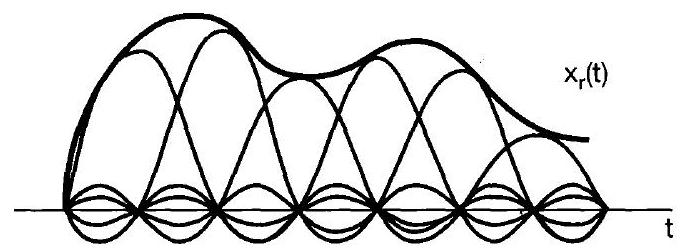
This equation describes band-limited interpolation. It shows that the reconstructed signal is a superposition of scaled and shifted sinc functions, where each sample \(x(nT)\) determines the amplitude of a sinc function centered at \(nT\).

Visualizing Ideal Band-Limited Interpolation

  • Original Signal \(x(t)\): A smooth, band-limited signal.
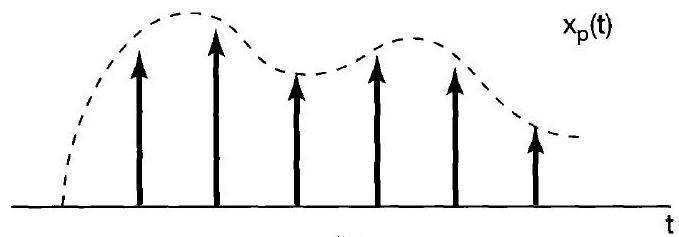
  • Impulse Train \(x_p(t)\): The signal represented by discrete impulses at sampling instants.
  • Superposition of Sincs: Each impulse is effectively replaced by a scaled sinc function. Their sum perfectly reconstructs \(x(t)\).
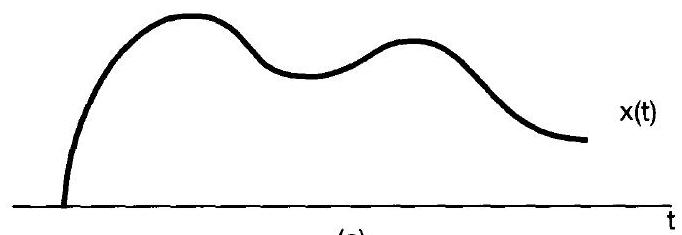
(a) Band-limited signal \(x(t)\)

(b) Impulse train of samples of \(x(t)\)

(c) Ideal band-limited interpolation

The Sinc Function: The Ideal Interpolator

  • The sinc function (normalized form sin(πx)/(πx)) is crucial for ideal reconstruction.
  • It’s an oscillatory function that decays over time.
  • Its Fourier Transform is a rectangular pulse (the ideal lowpass filter frequency response).

Tip

Key Property:

sinc(0) = 1

sinc(n) = 0 for all non-zero integers n.

This ensures that at each sample point nT, only \(x(nT)\) contributes, and at other sample points kT (where k != n), \(x(nT)\)’s sinc function is zero.

The Sinc Function: The Ideal Interpolator

Interactive Sinc Function

Practical Interpolation: Zero-Order Hold (ZOH)

  • Ideal filters are non-causal and unrealizable.
  • We need simpler, practical interpolators.
  • Zero-Order Hold (ZOH): The simplest form of interpolation.
    • Holds the value of each sample until the next sample arrives.
    • Produces a “stair-step” or “mosaic” effect.

Impulse Response (\(h_0(t)\)):

  • A rectangular pulse of duration \(T\) (sampling period).
    • \(h_0(t) = 1\) for \(0 \le t < T\)
    • \(h_0(t) = 0\) otherwise

Output: - \(x_0(t) = \sum_{n=-\infty}^{+\infty} x(nT) h_0(t-nT)\)

Warning

Limitation: A very rough approximation. The output is discontinuous.

ZOH Transfer Function & Limitations

  • The ZOH can be viewed as an approximation to the ideal lowpass filter.
  • Its transfer function is not ideal.

\[ H_0(j\omega) = T \frac{\sin(\omega T/2)}{\omega T/2} e^{-j\omega T/2} \] The magnitude, \(|H_0(j\omega)|\), has a sinc function (unnormalized) shape.

  • Pros: Simple, easy to implement in hardware.
  • Cons:
    • Significant high-frequency content (not a perfect lowpass filter).
    • Introduces distortion and aliasing artifacts if not followed by a good analog lowpass filter.
    • Output is discontinuous.

Practical Interpolation: First-Order Hold (Linear Interpolation)

  • First-Order Hold (FOH): Connects adjacent sample points with a straight line.
  • Provides a smoother output than ZOH.
  • Also known as linear interpolation.

Impulse Response (\(h_1(t)\)):

  • A triangular pulse of duration \(2T\), centered at \(T\).
    • \(h_1(t)\) increases linearly from 0 to 1 for \(0 \le t \le T\).
    • \(h_1(t)\) decreases linearly from 1 to 0 for \(T < t \le 2T\).
    • \(h_1(t) = 0\) otherwise.

Output: - Continuous, but with discontinuous derivatives (sharp corners at sample points).

Tip

Improvement: FOH offers a better approximation to the ideal filter compared to ZOH.
(a) System for sampling and reconstruction (with FOH impulse response)

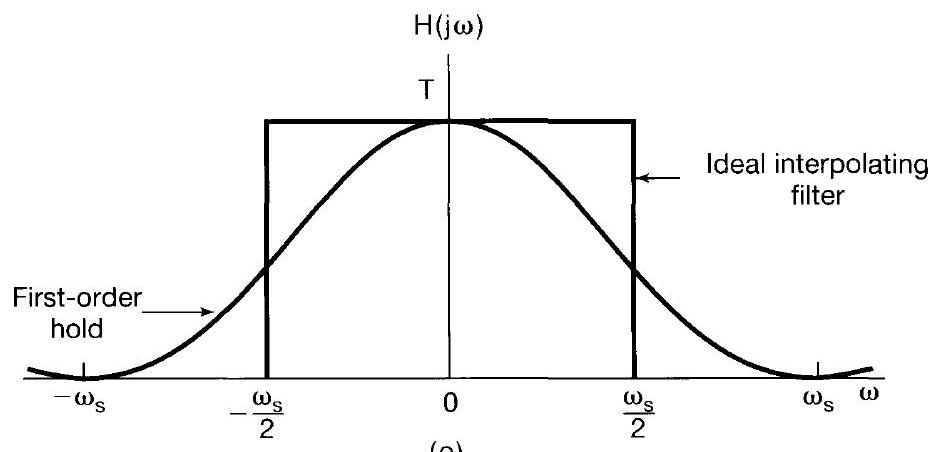
(e) Comparison of transfer function of ideal interpolating filter (solid) and first-order hold (dashed).

FOH Transfer Function & Higher-Order Holds

  • The FOH also has a non-ideal transfer function, but it’s closer to ideal than ZOH.

\[ H(j \omega)=\frac{1}{T}\left[\frac{\sin (\omega T / 2)}{\omega / 2}\right]^{2} \tag{7.12} \]

  • This is essentially the square of the ZOH magnitude response (with some scaling).

Important

Higher-Order Holds:

  • Can use higher-order polynomials for interpolation (e.g., cubic splines).
  • Provide even smoother reconstructions with continuous derivatives.
  • Come with increased computational complexity and potential for overshoot.

Interactive Interpolation Comparison

  • Observe the effects of ZOH and FOH on a sampled sine wave.
  • Adjust the sampling rate to see how it impacts reconstruction quality.

Summary & Key Takeaways

  • Reconstruction Goal: Convert discrete samples back to a continuous signal.
  • Ideal Reconstruction: Achieved with an ideal lowpass filter (sinc function) if Nyquist criterion is met.
    • Theoretically perfect, but practically unrealizable (non-causal).
  • Practical Interpolation:
    • Zero-Order Hold (ZOH): Simple, “stair-step” output, discontinuous.
    • First-Order Hold (FOH) / Linear Interpolation: Smoother, continuous output, but with discontinuous derivatives.
    • Higher-order holds offer greater smoothness at increased complexity.

Tip

Engineering Trade-offs:

Choosing an interpolation method involves balancing:

  1. Accuracy: How close is the reconstructed signal to the original?
  2. Complexity: Computational cost and hardware requirements (e.g., memory, processing power).
  3. Real-time Constraints: Can it be done fast enough for the application?
  4. Application Needs: What level of smoothness/fidelity is acceptable? (e.g., audio vs. control systems).