This chapter introduces the intuitive and formal definitions of limits.
It explores different types of limits: one-sided, infinite, and limits at infinity.
We will discuss limit theorems, practical evaluation techniques, and the concept of continuity.
Finally, we’ll cover key theorems like the Intermediate Value Theorem and Extreme Value Theorem.
4.1 Limit of a Function at a Point
Intuitive Idea of a Limit
What happens to \(f(x)\) for values of \(x\) near 2, when \(f(x) = x^2\)?
1. Computational Approach
Let’s look at values of \(f(x)\) as \(x\) gets closer to 2.
x
x²
x
x²
2.1
4.41
1.9
3.61
2.01
4.0401
1.99
3.9601
2.001
4.004001
1.999
3.996001
2.0001
4.00040001
1.9999
3.99960001
As \(x\) approaches 2, \(f(x)\) approaches 4.
2. Graphical Approach
Graph of \(f(x) = x^2\)
Observe the points on the graph of \(y=f(x)\) as \(x\) approaches 2. The y-values on the graph get closer to 4.
We write this as: \[\lim_{x \to 2} (x^2) = 4\]
Definition of a Limit at a Point
Suppose \(f\) is defined near \(x = a\) (but not necessarily at \(x=a\)).
We say that \(f(x)\) approaches the limit \(L\) as \(x\) tends to \(a\), if we can make \(f(x)\) arbitrarily close to \(L\) by choosing \(x\) sufficiently close to \(a\).
We express this by writing: \[\lim_{x \to a} f(x) = L\]
Note
Key Points:
Existence and Uniqueness: If \(\lim_{x \to a} f(x)\) exists, it means there is a unique real number \(L\).
Non-existence: If there is no finite real number \(L\), then \(\lim_{x \to a} f(x)\) does not exist.
Example: Limit with a Hole
Consider the function \(f(x) = \frac{1 - x^2}{1 - x}\).
1. Is \(f(1)\) defined?
If we substitute \(x=1\) into the function, we get \(\frac{1 - 1^2}{1 - 1} = \frac{0}{0}\), which is an indeterminate form.
Therefore, \(f(1)\) is not defined.
2. Guess the value of \(\lim_{x \to 1} f(x)\).
Let’s substitute values of \(x\) near 1:
x > 1
f(x)
x < 1
f(x)
1.5
2.5
0.5
1.5
1.1
2.1
0.9
1.9
1.01
2.01
0.99
1.99
1.001
2.001
0.999
1.999
1.0001
2.0001
0.9999
1.9999
As \(x\) approaches 1 from both sides, \(f(x)\) approaches 2. So, \(\lim_{x \to 1} f(x) = 2\).
Important
Even though \(f(1)\) is undefined, the limit \(\lim_{x \to 1} f(x)\) can still exist. This is a key distinction between function value and limit.
Multiple Approaching Values - No Limit
Does \(\lim_{x \to 0} \sin \left(\frac{1}{x}\right)\) exist?
Computational Approach
Let’s look at values of \(\sin(1/x)\) as \(x\) approaches 0.
x
sin(1/x)
x
sin(1/x)
\(1/\pi\)
0
\(2/\pi\)
1
\(1/(2\pi)\)
0
\(2/(5\pi)\)
\(\approx 0.58\)
\(1/(3\pi)\)
0
\(2/(9\pi)\)
\(\approx -0.98\)
\(1/(4\pi)\)
0
\(2/(13\pi)\)
\(\approx 0.74\)
\(1/(5\pi)\)
0
\(2/(17\pi)\)
\(\approx -0.99\)
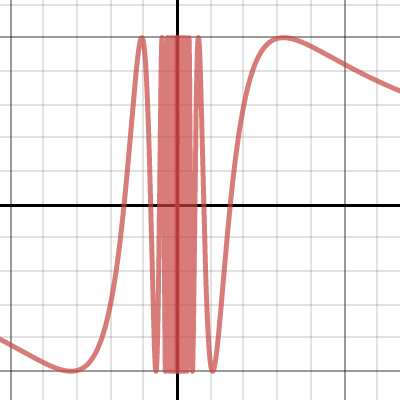
As \(x\) approaches 0, \(f(x)\) does not settle on a single value; it oscillates infinitely between -1 and 1.
Graphical Approach
Graph of \(y = \sin(1/x)\)
The graph oscillates wildly near \(x=0\), never settling to a single y-value.
Warning
Since \(f(x)\) does not approach a single real number as \(x \to 0\), the limit \(\lim_{x \to 0} \sin \left(\frac{1}{x}\right)\)does not exist.
4.2 One-sided Limit of a Function at a Point
Consider the function: \[
f (x) = \left\{ \begin{array}{cc} - 1 & x < 2 \\ 1 & x \geq 2 \end{array} \right.
\] Is there a real number where \(f(x)\) approaches as \(x\) approaches 2?
Approaching from the Left (x < 2)
x
f(x)
0.5
-1
1.9
-1
1.99
-1
1.999
-1
1.9999
-1
As \(x \to 2\) from the left, \(f(x) \to -1\). We write this as: \[\lim_{x \to 2^-} f(x) = -1\] This is the Left-hand Limit.
Approaching from the Right (x > 2)
x
f(x)
2.5
1
2.1
1
2.01
1
2.001
1
2.0001
1
As \(x \to 2\) from the right, \(f(x) \to 1\). We write this as: \[\lim_{x \to 2^+} f(x) = 1\] This is the Right-hand Limit.
Warning
Since \(\lim_{x \to 2^-} f(x) \neq \lim_{x \to 2^+} f(x)\), the limit \(\lim_{x \to 2} f(x)\)does not exist. There is no single value \(f(x)\) approaches as \(x \to 2\).
Equal One-sided Limits
The following theorem connects the existence of a general limit to its one-sided counterparts.
Tip
Theorem 4.2.2 (Equal One-sided Limits)
\(\lim_{x \to a} f(x) = L\)if and only if\(\lim_{x \to a^-} f(x) = L\) and \(\lim_{x \to a^+} f(x) = L\).
Remark: This result is extremely useful for evaluating limits at a point \(a\) if the function has different mathematical expressions for \(x < a\) and \(x > a\) when \(x\) is near \(a\).
Equal One-sided Limits
Example: Let \(g(x) = \left\{ \begin{array}{ll} x^2 & \text{if } 0 < x \leq 1 \\ 0.5 & \text{if } x = 0 \\ \sin x & \text{if } -1 \leq x < 0 \end{array} \right.\) Does \(\lim_{x \to 0} g(x)\) exist?
Since \(\lim_{x \to 0^-} g(x) = 0\) and \(\lim_{x \to 0^+} g(x) = 0\), both one-sided limits are equal to 0.
Therefore, by Theorem 4.2.2, \(\lim_{x \to 0} g(x) = 0\).
4.3 Infinite Limit
Let \(f\) be a function defined on both sides of \(a\), except possibly at \(a\) itself.
We write \(\lim_{x \to a} f(x) = \infty\) (or \(f(x) \to \infty\) as \(x \to a\)) if the values of \(f(x)\) can be made arbitrarily large (as large as we like) by taking \(x\) sufficiently close to \(a\) (but not equal to \(a\)).
Similarly, \(\lim_{x \to a} f(x) = -\infty\) means \(f(x)\) can be made arbitrarily negatively large.
4.3 Infinite Limit
Example 4.3.1: What is \(\lim_{x \to 0} \frac{1}{x^2}\)?
Let’s evaluate \(f(x) = \frac{1}{x^2}\) for small values of \(x\):
x
f(x)
x
f(x)
0.1
100
-0.1
100
0.01
10,000
-0.01
10,000
0.001
1,000,000
-0.001
1,000,000
0.0001
10^8
-0.0001
10^8
As \(x\) becomes close to 0, \(\frac{1}{x^2}\) becomes very large.
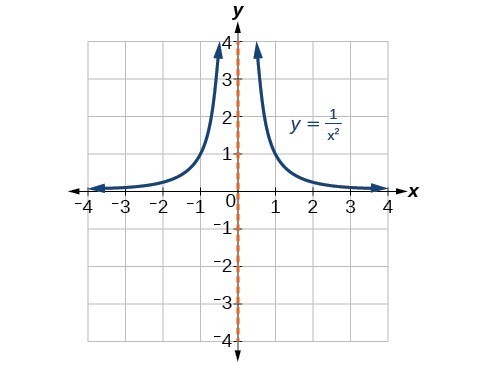
Graph of \(y = 1/x^2\)
The graph shows that as \(x\) approaches 0 from either side, \(y\) increases without bound.
Note
The limit \(\lim_{x \to 0} \frac{1}{x^2}\) technically does not exist in terms of a finite real number. However, to describe this specific “blow-up” behavior, we write: \[\lim_{x \to 0} \frac{1}{x^2} = \infty\]
Vertical Asymptotes
The vertical line \(x = a\) is called a vertical asymptote of the curve \(y = f(x)\) if at least one of the following statements is true:
The vertical line with equation \(x = 0\) (the \(y\)-axis) is a vertical asymptote of \(y = \frac{1}{x^2}\).
(As seen in the previous slide, \(\lim_{x \to 0} \frac{1}{x^2} = \infty\))
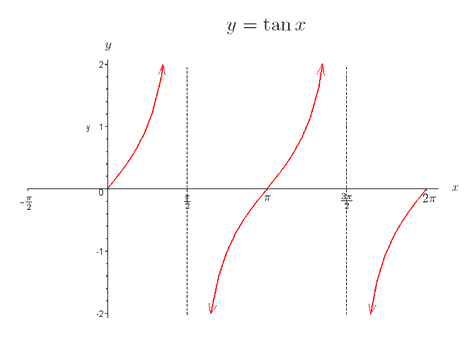
The lines \(x = \pm \frac{\pi}{2}\) are vertical asymptotes of the curve \(y = \tan x\).
(Think about the unit circle or the graph of tangent; it “blows up” at these points)
The vertical line \(x = 0\) is a vertical asymptote of \(y = \ln x\).
(The natural logarithm is only defined for \(x>0\), and as \(x \to 0^+\), \(\ln x \to -\infty\))
Graph of \(y = \tan x\)
4.4 Limits at Infinity
Let \(f(x)\) be a function defined on some interval \((a, \infty)\) (for large positive \(x\)) or \((-\infty, a)\) (for large negative \(x\)).
We write \(\lim_{x \to \infty} f(x) = L\) (or \(\lim_{x \to -\infty} f(x) = L\)) if the values of \(f(x)\) can be made as close to \(L\) as we like by taking \(x\) sufficiently large (or sufficiently negatively large).
4.4 Limits at Infinity
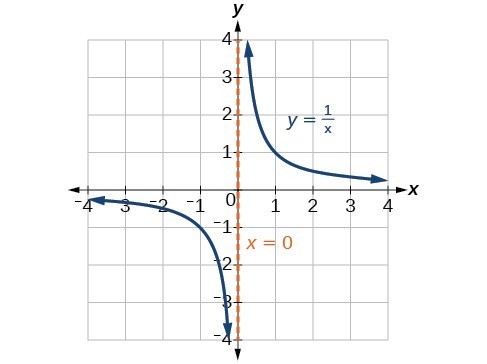
Example 4.4.1: For the function \(f(x) = \frac{1}{x}\), what happens to the values of \(f(x)\) as \(x\) increases to large positive values?
The graph shows that as \(x\) gets very large (positive or negative), \(y\) approaches 0. Similarly, \(\lim_{x \to -\infty} \frac{1}{x} = 0\).
Horizontal Asymptotes
The horizontal line \(y = b\) is called a horizontal asymptote of the curve \(y = f(x)\) if:
\[
\lim_{x \to \infty} f(x) = b \quad \text{or} \quad \lim_{x \to -\infty} f(x) = b.
\]
Examples of Horizontal Asymptotes:
For every positive integer \(n\), note that \(\lim_{x \to \infty} \frac{1}{x^n} = 0\), and \(\lim_{x \to -\infty} \frac{1}{x^n} = 0\).
The horizontal line \(y = 0\) (the \(x\)-axis) is a horizontal asymptote of \(y = \frac{1}{x^n}\).
Note that \(\lim_{x \to -\infty} e^x = 0\). The horizontal line \(y = 0\) is a horizontal asymptote of the curve \(y = e^x\).
(As \(x\) goes to positive infinity, \(e^x\) goes to infinity, so no horizontal asymptote there)
The following limits at infinity do not exist as finite numbers: \(\lim_{x \to \infty} \sin x\), \(\lim_{x \to \infty} \cos x\), \(\lim_{x \to \infty} \tan x\), \(\lim_{x \to \infty} e^x\), \(\lim_{x \to \infty} \ln x\).
(These functions either oscillate, grow infinitely large, or are undefined for large negative values)
Inverse tangent has horizontal asymptotes: \(\lim_{x \to \infty} \tan^{-1} x = \frac{\pi}{2}\)\(\lim_{x \to -\infty} \tan^{-1} x = -\frac{\pi}{2}\) So, \(y = \frac{\pi}{2}\) and \(y = -\frac{\pi}{2}\) are horizontal asymptotes.
4.5 Limit Theorems
Limit laws simplify the evaluation of complex limits by breaking them down into simpler components.
All the above Limit Laws hold for one-sided limits (\(\lim_{x \to a^+}\), \(\lim_{x \to a^-}\)) and limits at infinity (\(\lim_{x \to \infty}\), \(\lim_{x \to -\infty}\)).
Limits of Polynomials and Rational Functions
Limits of a Polynomial
Important
Theorem 4.5.9: For a polynomial \(p(x) = a_n x^n + a_{n-1} x^{n-1} + \dots + a_1 x + a_0\),
we have \(\lim_{x \to a} p(x) = p(a)\).
This means we can simply substitute the value of \(a\) into the polynomial \(p(x)\) to obtain the limit of \(p(x)\) at \(a\).
A function \(f(x)\) is a rational function if it is a quotient of two polynomials, i.e., \(f(x) = \frac{p(x)}{q(x)}\).
Important
Theorem 4.5.11: If \(f(x) = \frac{p(x)}{q(x)}\) and \(a\) is such that \(q(a) \neq 0\), then: \[
\lim_{x \to a} \frac{p(x)}{q(x)} = \frac{p(a)}{q(a)}.
\]
Again, we can simply substitute \(a\) into the function, provided the denominator is not zero.
We cannot apply direct substitution to find limits like: \[
\lim_{x \to 3} \frac{x^2 - 2x - 3}{x^2 - 9}
\]Why?
Because if we substitute \(x=3\) into the denominator, we get \(3^2 - 9 = 9 - 9 = 0\).
Similarly, substituting \(x=3\) into the numerator gives \(3^2 - 2(3) - 3 = 9 - 6 - 3 = 0\).
This gives us the indeterminate form \(\frac{0}{0}\).
Warning
In general, we cannot simply substitute values of \(a\) directly into the function \(f(x)\) to obtain the limit of \(f(x)\) at \(a\). Such substitution holds when the functions involved are continuous at \(a\). We shall discuss this concept of continuity in the next section.
4.6 Continuity
Most functions you’ve encountered in pre-university math are “nice” in the sense that their graphs are continuous.
Such functions allow us to substitute the value \(c\) directly into \(f(x)\) to evaluate \(\lim_{x \to c} f(x)\).
This “niceness” has a mathematical name: continuity at \(x = c\).
4.6 Continuity
Continuity at a Point
Important
Definition 4.6.1 (Continuity at a Point)
Let \(f\) be a function defined on an interval \(I\) and let \(c\) be an interior point of \(I\). We say that \(f\) is continuous at \(x = c\) if \[
\lim_{x \to c} f(x) = f(c).
\]
In words, this definition means three things must be true for \(f\) to be continuous at \(x = c\):
\(f(c)\) is defined. The function must have a value at \(c\).
\(\lim_{x \to c} f(x)\) exists. The limit as \(x\) approaches \(c\) must be a finite number.
\(\lim_{x \to c} f(x) = f(c)\). The limit must be equal to the function’s value at \(c\).
Tip
Continuity at \(x=c\) means we can interchange the order of “lim” and “f”:
Many common functions are continuous on their natural domains.
Note
Basic Functions Continuous on their Domains:
Polynomials, rational functions (where denominator \(\neq 0\)), \(\sqrt[n]{x}\), \(\sin x\), \(\cos x\), \(\tan x\) (where defined), \(e^x\), and \(\ln x\) (where defined) are continuous at every point in their domain.
Limits of Basic Functions (Theorem 4.6.3)
Since these functions are continuous, their limits can be found by direct substitution:
\(\lim_{x \to c}\tan x = \tan c\) (where \(\tan c\) is defined)
\(\lim_{x \to c} b^x = b^c\) for any \(b > 0\); in particular, \(\lim_{x \to c} e^x = e^c\).
\(\lim_{x \to c}\ln x = \ln c\) (where \(c > 0\))
\(\lim_{x \to c}\sinh x = \sinh c\)
\(\lim_{x \to c}\cosh x = \cosh c\)
\(\lim_{x \to c}\tanh x = \tanh c\)
Inverse trigonometric and hyperbolic functions are continuous at \(c\) (not endpoints).
Example 4.6.2:
\(f(x) = \sin x\) is continuous for each \(x \in \mathbb{R}\).
\(g(x) = \ln x\) is continuous for each \(x \in (0, \infty)\).
\(h(x) = \tan x\) is continuous for each \(x \in \mathbb{R} \setminus \{ \frac{\pi}{2} + k\pi \mid k \in \mathbb{Z} \}\).
Test for Continuity - Examples
To check if a function \(f\) is continuous at \(x = c\), we must verify all three conditions:
\(f(c)\) is defined.
\(\lim_{x \to c} f(x)\) exists.
\(f(c) = \lim_{x \to c} f(x)\).
Example 4.6.4:
Consider \(f(x) = \frac{1 - x^2}{1 - x}\). Is \(f\) continuous at \(x = 1\)?
\(f(1)\) is defined? No, \(f(1) = \frac{0}{0}\) (undefined).
Therefore, \(f\) is not continuous at \(x = 1\).
(Note: We previously found \(\lim_{x \to 1} f(x) = 2\), so (ii) exists, but (i) fails.)
Test for Continuity - Examples
Example 4.6.5:
Let \(f: \mathbb{R} \to \mathbb{R}\) be defined by \(f(x) = \left\{ \begin{array}{ll} 1 & \text{for } x = 2 \\ 0 & \text{for } x \neq 2 \end{array} \right.\). Is \(f\) continuous at \(x = 2\)?
\(f(2)\) is defined? Yes, \(f(2) = 1\).
\(\lim_{x \to 2} f(x)\) exists?
As \(x \to 2\) from left or right, \(x \neq 2\), so \(f(x) = 0\). Thus, \(\lim_{x \to 2} f(x) = 0\).
\(f(2) = \lim_{x \to 2} f(x)\)? No, \(1 \neq 0\).
Therefore, \(f\) is not continuous at \(x = 2\). This is a removable discontinuity (a “point discontinuity”).
Example 4.6.6:
Let \(f(x) = \left\{ \begin{array}{ll} \sin \frac{1}{x} & \text{for } x \neq 0 \\ 1 & \text{for } x = 0 \end{array} \right.\). Is \(f\) continuous at \(x = 0\)?
\(f(0)\) is defined? Yes, \(f(0) = 1\).
\(\lim_{x \to 0} f(x)\) exists? No, as seen before, \(\lim_{x \to 0} \sin \frac{1}{x}\)does not exist.
Therefore, \(f\) is not continuous at \(x = 0\). This is an oscillating discontinuity.
4.7 One-sided Continuity
Sometimes, a function is continuous only from one side at a boundary point of its domain.
Important
Definition 4.7.1 (One-sided Continuity)
We say that \(f\) is continuous from the left at \(x = c\) if \(\lim_{x \to c^-} f(x) = f(c)\).
We say that \(f\) is continuous from the right at \(x = c\) if \(\lim_{x \to c^+} f(x) = f(c)\).
4.7 One-sided Continuity
Example 4.7.2: Discuss the continuity of the Heaviside function \(H\) at \(x = 0\): \[
H(x) = \left\{ \begin{array}{ll} 0 & \text{for } x < 0 \\ 1 & \text{for } x \geq 0 \end{array} \right.
\]
Therefore, \(H(x)\) is not continuous at \(x = 0\).
One-sided continuity check:
Continuous from the right?\(\lim_{x \to 0^+} H(x) = 1\) and \(H(0) = 1\). Since \(\lim_{x \to 0^+} H(x) = H(0)\), \(H\) is continuous from the right at \(x = 0\).
Continuous from the left?\(\lim_{x \to 0^-} H(x) = 0\) and \(H(0) = 1\). Since \(\lim_{x \to 0^-} H(x) \neq H(0)\), \(H\) is not continuous from the left at \(x = 0\).
4.8 Properties of Continuity
Just like limit laws, continuity has properties that apply to combinations of functions.
Important
If \(f\) and \(g\) are continuous at \(x = c\), then the following combinations are also continuous at \(x = c\):
\(f \pm g\) (sum or difference)
\(f \cdot g\) (product)
\(f / g\) (quotient, provided \(g(c) \neq 0\))
Proof Sketch (for Sum/Difference):\[
\begin{aligned}
\lim_{x \to c} (f \pm g)(x) &= \lim_{x \to c} f(x) \pm \lim_{x \to c} g(x) & \text{(by Limit Law 2)} \\
&= f(c) \pm g(c) & \text{(since } f, g \text{ are continuous at } c) \\
&= (f \pm g)(c) & \text{(by definition of sum/difference)}
\end{aligned}
\] This matches the definition of continuity at \(c\).
Here, \(g(x) = x+20\) and \(f(y) = \sqrt[3]{y}\). Also \(h(x) = \frac{\pi x}{2}\) and \(k(y) = \cos y\). Both \(\sqrt[3]{y}\) and \(\cos y\) are continuous everywhere.