Machine Learning

03 Regression: Fundamentals, Implementation, and Evaluation

Imron Rosyadi

00. Introduction of Regression

Regression

Regression Introduction Image

Mathematical Model
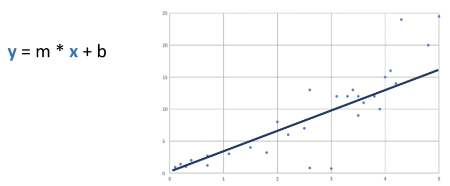
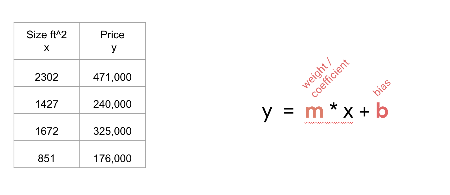
Mathematical Model for Linear Regression

Features Go In, Targets Come Out
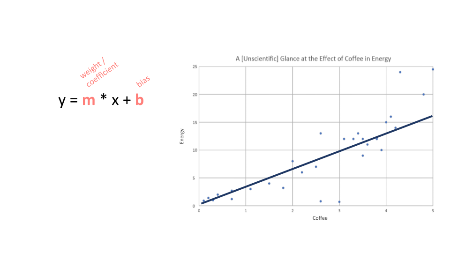
Features and Targets in Machine Learning

What is the Machine “Learning?”
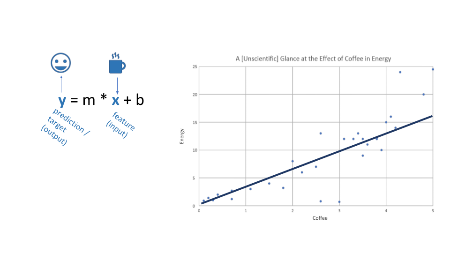
Weights and Biases in Linear Regression

Multiple Features
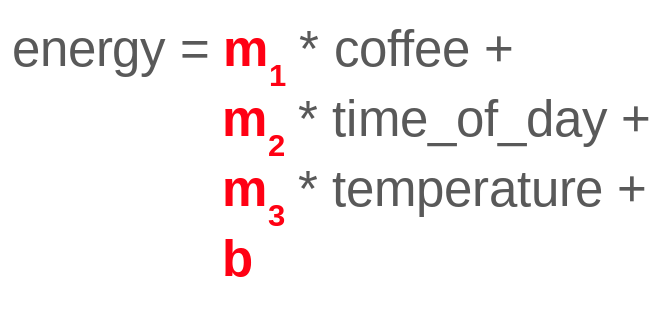
Multiple Features in Regression

Machine Learning Process

  1. Infer/Predict/Forecast
  2. Calculate Error/Loss/Cost
  3. Train/Learn (Update parameters)
  4. Iterate/Repeat (until some stopping condition)

Note

This iterative cycle is fundamental to how most machine learning algorithms “learn” from data.

Machine Learning Process Flow

graph TD
    A[Start] --> B{Data Input};
    B --> C[Predict Target];
    C --> D[Compare to Actual Target];
    D --> E[Calculate Error/Loss];
    E --> F["Update Model Parameters <br> (Weights & Bias)"];
    F --> G{Stopping Condition Met?};
    G -- No --> C;
    G -- Yes --> H[Model Converged];

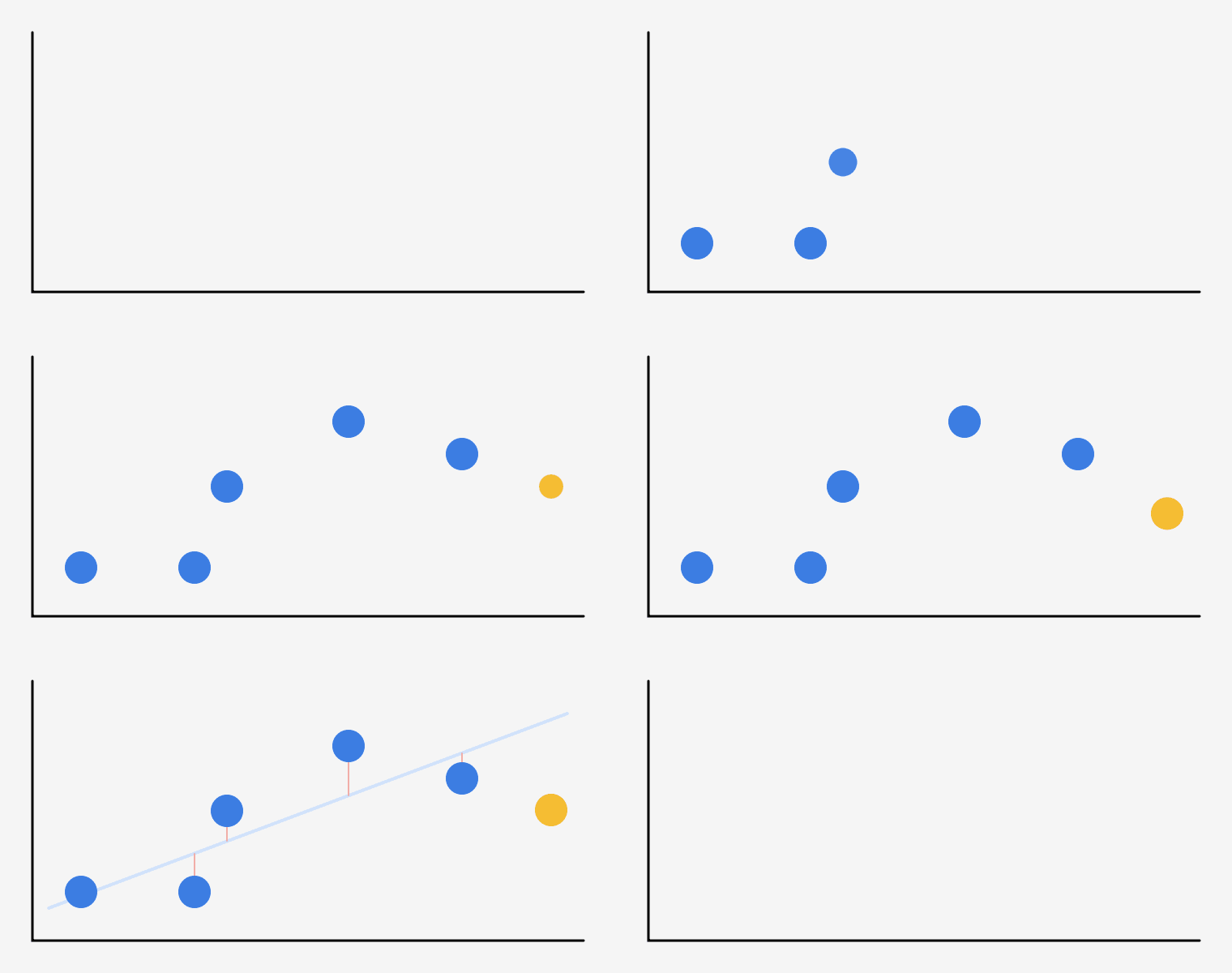
Predict the Selling Price of a House

House Price Data

Predict the Price of a House Using the Machine Learning Process
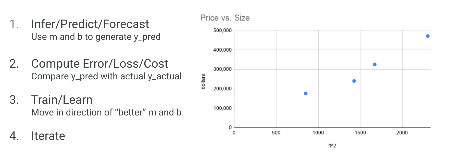
House Price Scatter Plot

Predict the Price of a House Using the Machine Learning Process
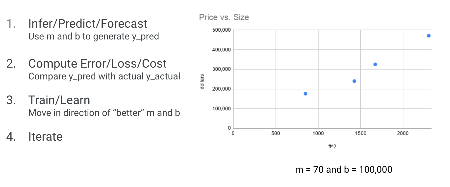
Initial Guess for Line

Predict the Price of a House Using the Machine Learning Process
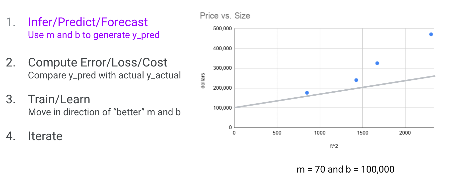
Line from Initial Guess

Predict the Price of a House Using the Machine Learning Process
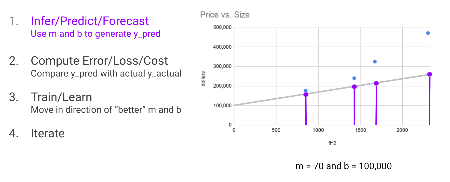
Predicted Values Example

Predict the Price of a House Using the Machine Learning Process
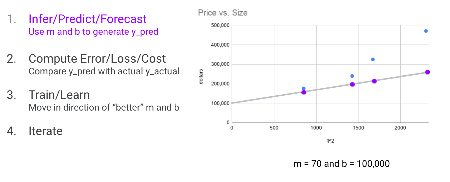
Actual vs Forecasted Values

Predict the Price of a House Using the Machine Learning Process
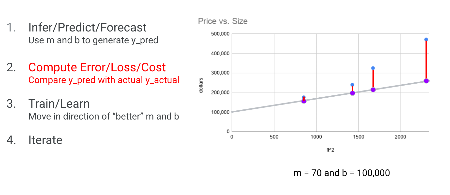
Error Calculation Illustration

Predict the Price of a House Using the Machine Learning Process
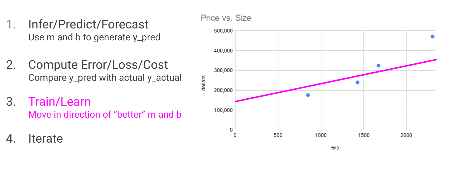
Updated Line Illustration

Interactive: Tuning Our Regression Model

Adjust the weight (slope) and bias (intercept) to fit the data and minimize the Mean Squared Error (MSE).

Error/Loss/Cost Functions

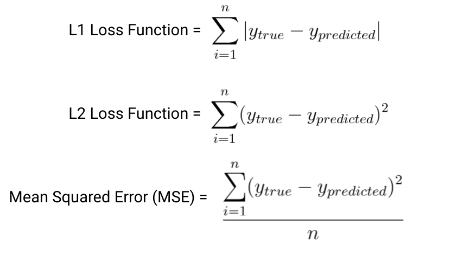
Common Loss Functions

Housing Example
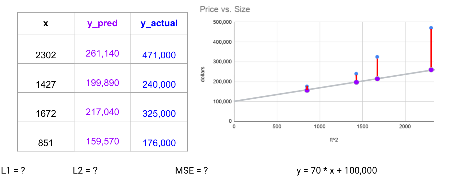
Housing Example Data Table

Housing Example (L1 Loss)
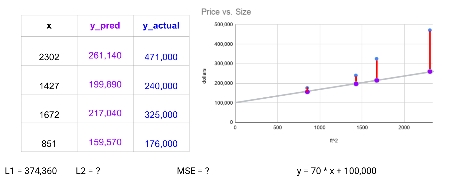
L1 Loss Calculation

Housing Example (L2 Loss)
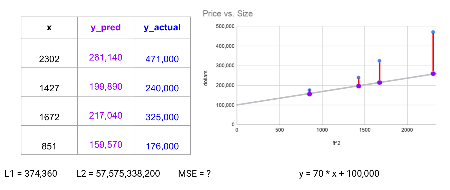
L2 Loss Calculation

Housing Example (MSE)
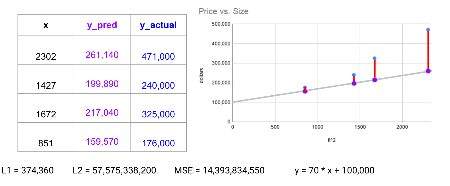
MSE Calculation

Computer vs. Human Jobs

The computer’s job:

  • Start with an arbitrary guess of parameters.
  • Tweak these parameters to reduce loss.
  • The less the loss is changing, the less the value should be tweaked.

The human’s job:

  • Choose the learning rate, a constant value which scales how far we tweak the value during each iteration.

Important

Learning rate is a hyperparameter - not a parameter in the actual model.

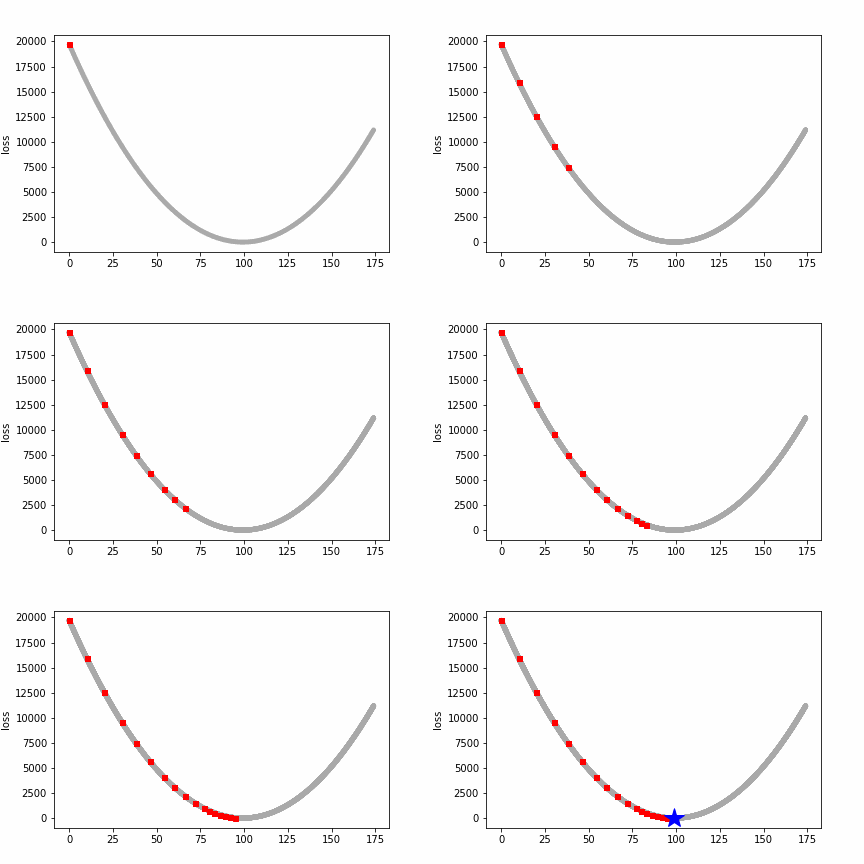
Gradient Descent

Gradient Descent Illustration

Linear Algebra Notation for \(y=mx+b\)
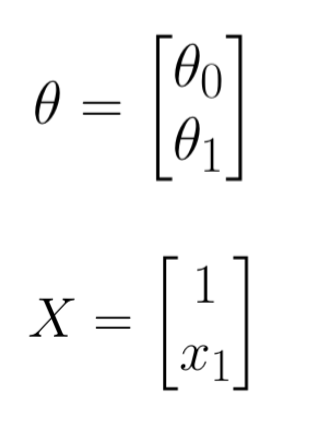
Linear Algebra Notation for Single Feature

Linear Algebra Notation for \(y=mx+b\)
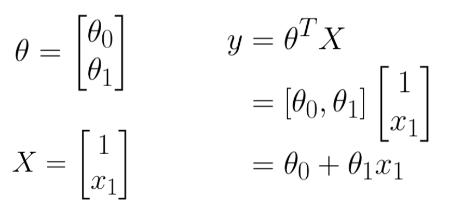
Compact Linear Algebra Notation

Multiple Regression (i.e. Multiple Features)
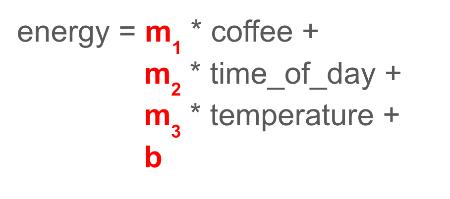
Multiple Features in Multiple Regression

Multiple Regression Notation
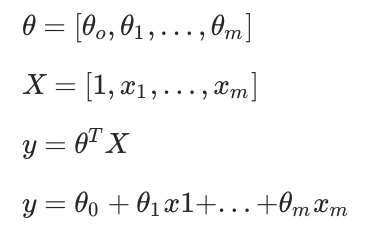
Multiple Regression Compact Notation

Closed Form, Exact Solution

\[ \theta = (X^{T} \cdot X)^{-1} \cdot X^{T} \cdot y \]

  • Good for small datasets
  • Finds optimal solution
  • Can be computationally expensive
  • Requires an invertible matrix

Batched Data

Break data into smaller batches.

  • We’ll use a new batch on each learning step.
  • New hyperparameter batch size controls how much data is used for each learning step.
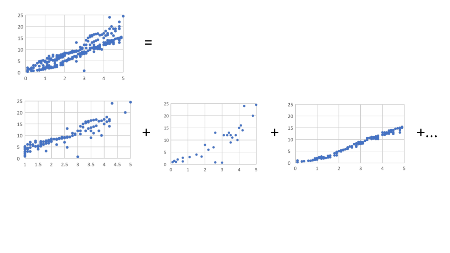
Batched Data for Training

Hyperparameters We Care About
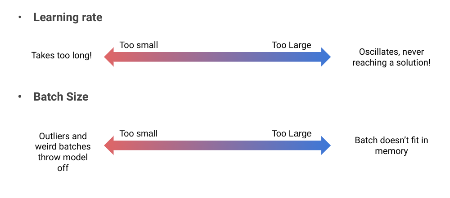
Hyperparameter Tuning Guidelines

01. Introduction to scikit-learn

scikit-Learn

Datasets

Loading

Fetching

Generating

Bunches

Estimators

Transformers

Pipelines

Metrics

Your Turn

02. Linear Regression with scikit-learn

Linear Regression

Linear Regression Fit Animation

scikit-learn: Using Linear Algebra

Note

This is not a learning algorithm that iteratively optimizes. It’s a direct, closed-form solution.

Optimizers

  1. (Batch) Gradient Descent
  2. Stochastic Gradient Descent (SGD)
  3. Mini-Batch Gradient Descent

scikit-learn: Stochastic Gradient Descent

scikit-learn: SGD Hyperparameters

scikit-learn: SGD partial_fit

from sklearn.linear_model import SGDRegressor

sgd_reg = SGDRegressor()
sgd_reg.partial_fit(X_1, y_1)
sgd_reg.partial_fit(X_2, y_2)
...
sgd_reg.partial_fit(X_n, y_n)
sgd_reg.coef_, sgd_reg.intercept_

Loss

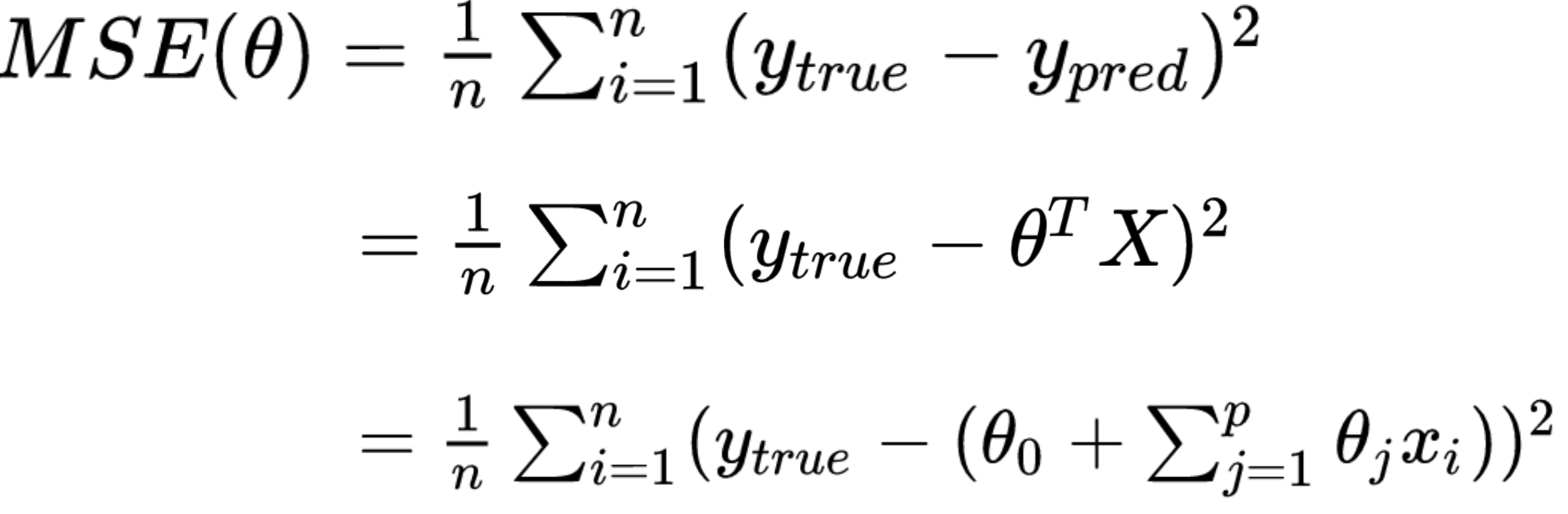
Mean Squared Error

\[ MSE = \frac{1}{n} \sum_{n=1}^{n}(y_{i} - \hat{y_{i}})^{2} \]

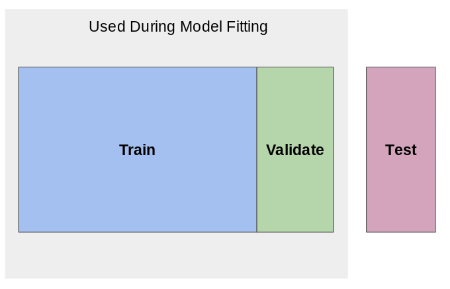
Train/Validate, Test

Train, Validate, Test Split

Train/Validate, Test, Validate
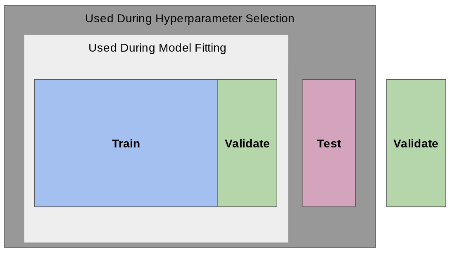
Double Validation Process

Your Turn

03. Regression Quality

Coefficient of Determination (\(R^2\))

\[ SS_{res} = \sum_{i}(y_i - \hat{y_i})^2 \] \[ \bar{y} = \frac{1}{n}\sum_{i=1}^{n}y_{i} \] \[ SS_{tot} = \sum_{i}(y_{i}-\bar{y})^2 \] \[ R^{2} = 1 - \frac{SS_{res}}{SS_{tot}} \]

Mean Squared Error (MSE)

\[ MSE = \frac{1}{n} \sum_{n=1}^{n}(y_{i} - \hat{y_{i}})^{2} \]

Root Mean Squared Error (RMSE)

\[ RMSE = \sqrt{\frac{1}{n} \sum_{n=1}^{n}(y_{i} - \hat{y_{i}})^{2}} \]

Note

RMSE returns the error in the original units of the target variable for easier interpretation.

Mean Absolute Error (MAE)

\[ MAE = \frac{1}{n} \sum_{n=1}^{n}(|y_{i} - \hat{y_{i}}|) \]

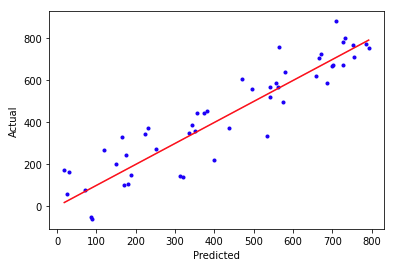
Predicted vs. Actual Plots

Good Predicted vs Actual Plot

Predicted vs. Actual Plots (Positive Bias)
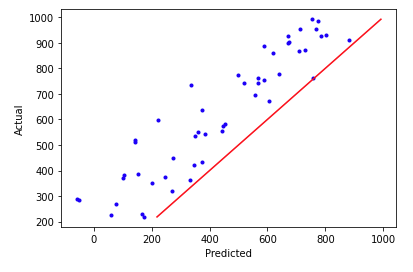
Predicted vs Actual Plot with Positive Bias

Residual Plots
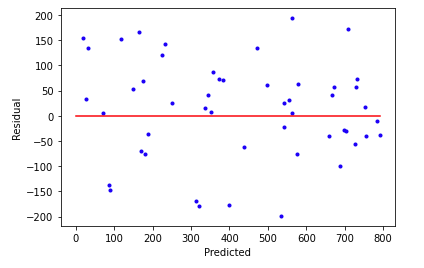
Good Residual Plot

Residual Plots (Bias Example)
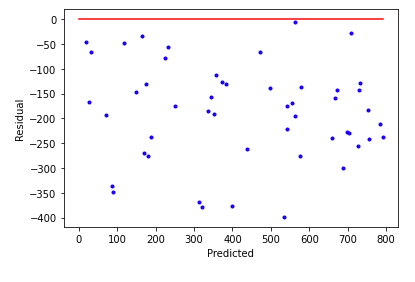
Residual Plot with Bias
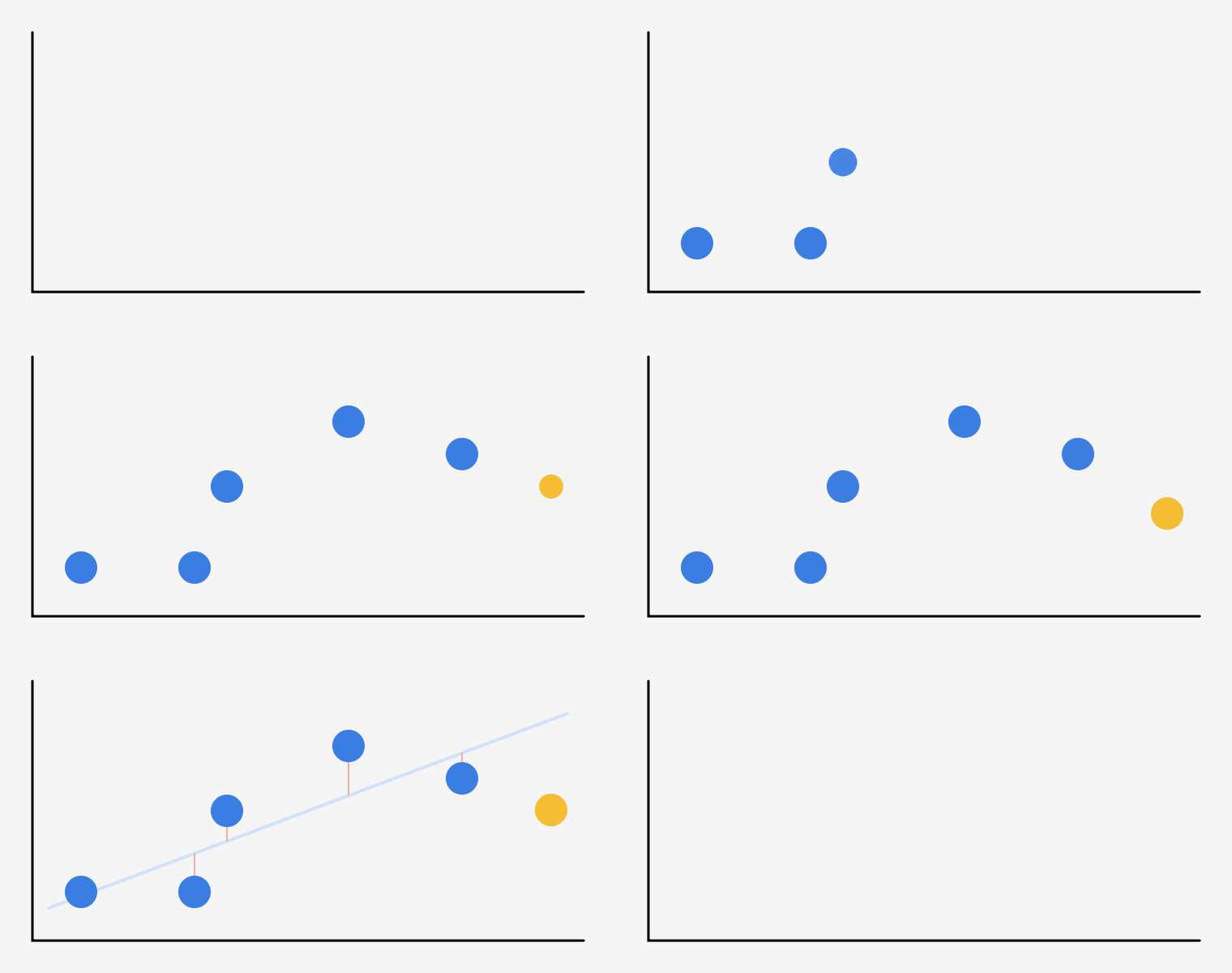
Your Turn

04. Polynomial Regression & Overfitting

Outline

  1. Recall Linear Regression
  2. Polynomial Regression: What is it and how is it different (or not so different)?
  3. Caution! Dangers of polynomial regression!

Tip

Understanding when and how to use polynomial regression is key to modeling complex system behaviors in ECE.

Linear Regression Fit Animation

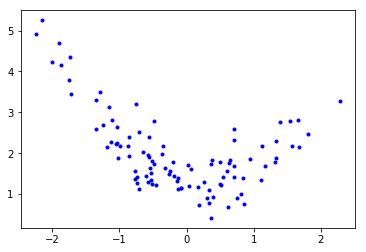
Dataset for Polynomial Regression
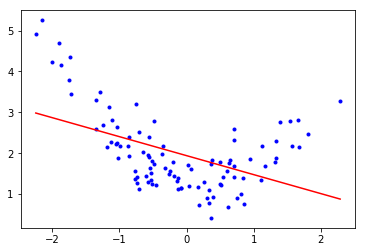
Linear Fit on Non-linear Data
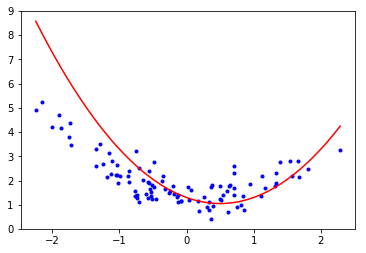
Polynomial Fit on Non-linear Data

Polynomial Equations
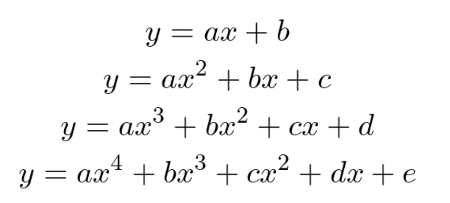
Examples of Polynomial Equations
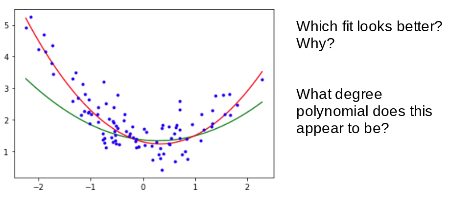
What is the Original Curve?
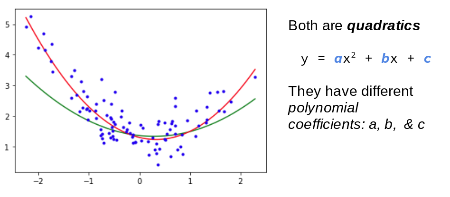
Original Polynomial Curve
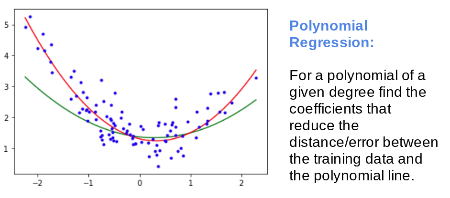
Polynomial Regression Process
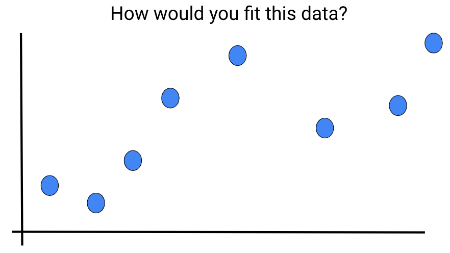
Polynomial Regression = Linear Regression

Turn the original polynomial regression problem into a polynomial regression problem with multiple features.

G Input_x Original Feature (x) Transformation Polynomial Feature Transformation Input_x->Transformation Applies powers Features_X_prime Transformed Features ([1, x, x^2, x^3, ...]) Transformation->Features_X_prime New Features (X') Linear_Regression_Model Linear Regression Model (w_0, w_1, w_2, w_3, ...) Features_X_prime->Linear_Regression_Model Input for fitting Output_y_hat Predicted Target (y_hat) Linear_Regression_Model->Output_y_hat Prediction

Overfitting

Dataset for Overfitting Example

Overfitting Demonstration

Overfitting Analogy: Clothing Fit

Well-fitting shirt

Overfitted clothing

Underfitted clothing

Just right fit
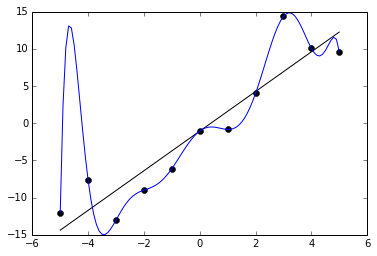
Illustration of Overfitting Regression

How Do We Avoid This?

Avoiding Overfitting

  • Simpler polynomial
  • More training data
  • Dropping out some training data (e.g., regularization)
  • Overfitting penalties (regularization)

Important

Regularization is a key technique to manage overfitting by adding penalties to model complexity.

Regularization

Recall: Mean Squared Error

Mean Squared Error Formula Breakdown

Lasso (L1) Regularization
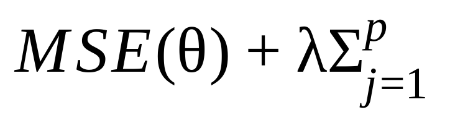
Lasso (L1) Regularization Formula

Ridge (L2) Regularization
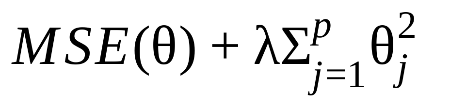
Ridge (L2) Regularization Formula

ElasticNet (L1 + L2)

Which Regularization Is Best?

Caution

The choice of regularization often depends on the specific dataset and problem. Experimentation is key!

Your Turn